Here is some general info on fish tanks.
Water Conditions
Water ph
Water ph is very important. The ph rating that some fish require varies a lot. Ph can be acidic, neutral or alkaline. Neutral is ph 7.0, acidic is lower than 7.0, and alkaline is higer than 7.0. You can test the ph with strips that you dip in the water, which you should be able to find at pet stores.
Ammonia-Nitrite-Nitrate
All three of these things are bad for your aquarium. Ammonia is the worst,Nitrite is second, and Nitrate is the least bad.You should let your aquarium run without fish with the filter running for at least 2 weeks to get rid of these harmful chemicals. These can be tested with dip strips just like ph.
Starting an Aquarium
This is a step by step way to set up an aquarium.
Gravel
First,if you are using an undergravel filter,place it in the aquarium. We are assuming that the tank is empty. Empty the gravel into a large bucket. Fill the bucket with water and shake it, then empty the water out of the bucket. Repeat this until the water is clear when you dump it out. Do the same with sand, but don't use an undergravel filter. Now gently dump the gravel into the aquarium and level it out.
Adding Decorations
First, you put in any rocks or fake driftwood. Put them wherever you think they should go. You should already have the gravel in. Next you put in any real wood you are going to use. Before you put in the wood you need to soak it in a bucket of water. Dump the water out when water is tea colored and reapeat until water is clear. Now you can place the wood in the aquarium. Before you add artificial or real plants you should fill the tank up halfway with water. Now you can place fake or real plants in the aquarium. When putting in live plants, bury the roots but don't bury too much of the plant. You should use plants to hide your filter and heater, but make sure you don't put them so close that they wiil be sucked into the filter or burnt by the heater.
Adding Filters, Heaters, and Air Stones
While the aquarium is halfway filled, stick the heater to the wall of the aquarium in a position where it won't burn anything. Now you can fill the aquarium all the way. When filling the aquarium, you should pour the water on to a plate on top of the gravel so the gravel is not disturbed. Watch where the heater's fill line is. Now put in the filter. Once you have your filter in you put the airstone on the end of the tube connected to the aerator. Put the air stone wherever you want.
Plugging it in
Now that you have everything in place,you can plug everything in. Right away the air stone should be bubbling and the filter should be running. In 30 minutes, the water temperature should be 78 to 82 degrees F. If you are not keeping tropical fish you won't need a heater. Now put the aquarium hood and light fixture on top and plug it in.
Let the aquarium run for 2 weeks before adding fish.
Types of tanks
Community
A community tank is a tank with different types of fish that live together in harmony. In a community, there needs to be a a balance of fish that swim in the top, middle, and bottom of the water. The fish also must have similar ph and food requirements. Although this type of tank is the most popular, it is actually the hardest to maintain.
Species Tank
In this tank, you have 1 or more of only 1 type of fish. The water conditions should suit the species of fish perfectly. This is the easiest kind of tank to maintain
Breeding Tank
This kind of tank is specially formulated for a pair of fish to breed in. It is very similar to the species tank.
Biotype Tank
A biotype tank contains fish from the same area in the world(ex. Amazon,Malawi,etc.). This is easier than a community tank because all of the fish in the tank have the same requirements.
Mini Tank/Bowl
These tanks will be considered 5 gallons or under. They don't need a filter or a heater, but if you do get those you will have a wider variety of compatible fish to choose from. You do need an aererator unless all you have is a betta. Some good options for an unfiltered, unheated, airerated bowl would be bettas(in anabantoids), white clouds(in cyprinids), and small fundulopanchax or aphosemion killifish (in killifish).
Adding fish
Buying Fish
These are some important things to remember when buying fish. Always observe fish carfully before buying. Check for ripped fins, pale colors, and other faults. If you want a pair, some differences in males and females are size and color. Make sure the person who gets your fish gets the right ones.
Adding fish
You should never just dump new fish into your tank. First, open the bag and let the bag and fish float in the water. Let the bag float for 10 minutes or until the water temp is the same as in the tank. Then net the fish and let it go in the tank. Watch it to make sure it is not bullied by other fish. Don't dump the water in the bag in to the aquarium.
Maintenance
Weekly
First, scrape algae off of glass. Next, use a gravel vacuum to do a water change.The water change should be 10 to 20% of the tank volume.
Monthly
Change the filter media.
Feeding
What food
When feeding your fish, look at their mouth to know what they eat. If the mouth is pointed up, this fish needs floating food. If the mouth is pointing down, feed this fish sinking food. If the mouth is in the middle, it should eat food that sinks slowly. Many fish are picky, so if they won't eat you should give them live or frozen bloodworms, brine shrimp, or other livefoods. You should feed your fish at least 2 times a day. They should be fed a staple diet of flakes and pellets, and a supplement of live or frozen food 1-2 times a week.
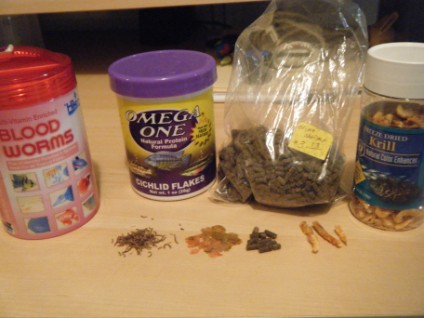
Fish benefit from being fed a variety of food.
